 by
by 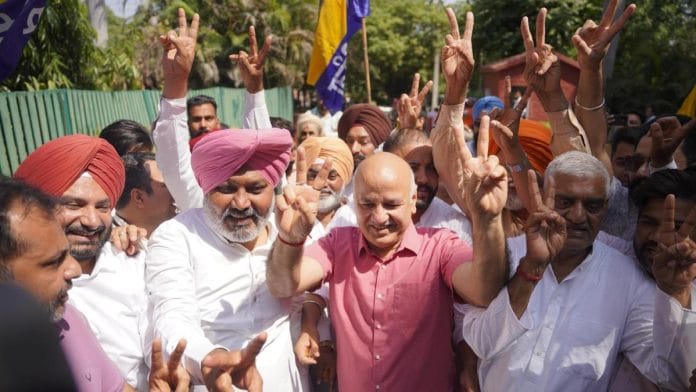
Punjab Municipal Elections: AAP Solidifies Its Position as Rivals Struggle
In a significant electoral exercise, over 22.38 lakh voters, representing nearly 64% of the electorate, participated in the recent municipal elections across Punjab. This included the election of representatives for 8 municipal corporations, 75 municipal councils, and 19 Nagar Panchayats, with 7,555 candidates vying for positions. These elections were viewed as a crucial precursor to the Punjab Assembly polls scheduled for early 2027.
Despite opposition claims of malfeasance, the Aam Aadmi Party (AAP) asserted that the election results reaffirmed its status as the leading political force in Punjab after four years in governance. Congress made notable gains in Kapurthala, while the BJP emerged victorious in Abohar, where AAP secured the second position. In Pathankot, traditionally a BJP stronghold, the party won the most wards, yet failed to achieve a majority, with Congress trailing behind. The Akali Dal, however, did not secure a majority in any civic body.
AAP's dominance was particularly evident in the municipal councils and Nagar Panchayats, where it retained a stronghold that has buoyed its political fortunes since the 2022 Assembly elections. This suggests that the party continues to resonate with lower- and middle-income urban voters. Chief Minister Bhagwant Mann, speaking at a press conference, emphasized the public's endorsement of AAP’s governance, stating,
“Vidhan Sabha, Lok Sabha, panchayat elections and now municipal elections…the Aam Aadmi Party has won in a big way.”
Electoral Landscape After the Vote
The election results indicate that AAP has mitigated some of the anti-incumbency sentiment that had been building in certain areas. In many regions previously dominated by Congress and the Akalis, AAP either won decisively or positioned itself as a formidable contender. Notably, AAP's performance in SAS Nagar, where it secured 27 of 50 wards, was hard-fought, with Congress claiming 12, while the Akalis and BJP took 4 and 3 wards, respectively.
AAP’s sweeping victories in councils across multiple districts, including Sri Muktsar Sahib and Dhuri, solidified its standing in local governance. Analysts point to several factors contributing to AAP's success, including a vigorous anti-drug campaign, which has become a politically sensitive issue in Punjab. The government's initiatives, like the Rs 10 lakh free health insurance scheme, have also resonated with economically vulnerable voters, contributing to a perception that AAP is addressing long-standing issues.
Challenges for the Opposition
In contrast, the opposition parties struggled to mount a compelling narrative against AAP. The Congress party, despite being the main opposition, remains mired in internal conflicts and has failed to capitalize on local grievances. State Congress chief Amarinder Singh Raja Warring criticized AAP for its alleged misuse of power, asserting that their tactics were evident throughout the election cycle. He stated,
“I reaffirm and reiterate that the AAP will not win even ten seats in 2027.”
The BJP's performance was equally lackluster, failing to establish itself as a serious contender in urban Punjab post-split from the Akali Dal in 2020. The party did secure notable victories in Abohar and Fazilka, but overall, it remains distant from the organizational strength necessary for state-level success.
The Akali Dal's Decline
The Akali Dal's presence continues to diminish, with only a handful of wards won across various municipal corporations. Although it showed signs of survival in specific areas, such as Bathinda and Moga, the party is far from reclaiming its former statewide influence. Sukhbir Singh Badal, the party's state chief, lamented the electoral circumstances, claiming oppression by the ruling party, stating,
“Despite widespread suppression... the people of Punjab have clearly shown where their faith lies.”
As the political landscape shifts, questions arise for both the BJP and the Akali Dal regarding strategies to effectively challenge AAP in the future. Political analysts suggest that without a significant change in approach, both parties may struggle to pose a serious threat to the ruling government.
While AAP's electoral success is notable, experts caution that it does not guarantee a win in the 2027 Assembly elections. Dr. Kanwalpreet Kaur from DAV College remarked that while the municipal results provide a psychological advantage, the larger electoral canvas of Assembly elections presents an entirely different challenge. With opposition parties facing mounting pressures, the results may serve as an early indicator of the direction the 2027 Assembly battle is likely to take.
Comments