 by
by 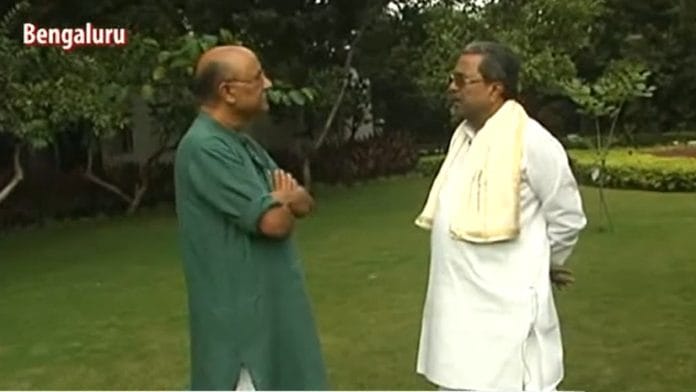
Siddaramaiah: A 100% Politician in Karnataka's Political Landscape
In an engaging interview with Shekhar Gupta in 2017, Karnataka's longest-serving Chief Minister, Siddaramaiah, confidently embraced his identity as a politician. When asked if he could be considered a "100 percent politician," he affirmed,
“Yes, I am a politician, no doubt on that.”However, he clarified that while he thinks about politics continuously, he does not operate as a politician every hour of the day.
The conversation delved into the heavy responsibilities that come with his role. Siddaramaiah emphasized his commitment to social justice, stating that his focus lies in empowering marginalized groups in society. He expressed a strong desire to uplift those who have historically been deprived of opportunities, reinforcing his dedication to the state's development.
Despite the Congress party's current standing, with only Karnataka and Punjab as major strongholds, Siddaramaiah rejected the notion that the party is diminished. He pointed out that past defeats have not permanently crippled the Congress, citing its resurgence after losing in 1977. He noted,
“Congress party is a strong political party in the country, with a strong base.”
Reflecting on his decade in the Congress, Siddaramaiah highlighted the party's ideological strengths in social justice and secularism, but acknowledged the need to invigorate its grassroots workers. He confirmed efforts in Karnataka to strengthen the party's cadre, stating,
“Yes, in Karnataka we are building.”
As the interview progressed, Siddaramaiah discussed the concept of "Ahinda," representing the backward classes, Dalits, and minorities, and how it differs from Bahujan Samaj. He stated,
“Ahinda means the people who are deprived of their rights.”He underscored his representation of the Kurpa community, which is classified as backward within the state's demographics.
Addressing the topic of regional identity versus Hindutva, he asserted that the achievements and promises fulfilled by his government serve as a counter to divisive politics. He maintained a firm stance against the imposition of Hindi in Karnataka, asserting that while Hindi is part of the three-language formula, it should not be forced upon the people.
On the subject of a potential state flag, Siddaramaiah mentioned that the Karnataka flag has been in use since 1966 by Kannada activists and emphasized that the Constitution does not prohibit a state flag. He expressed confidence that a state flag would not undermine national unity.
As the conversation shifted to the political landscape, Siddaramaiah criticized the BJP for its divisive strategies, asserting,
“The BJP is a divisive force.”He dismissed the significance of controversies surrounding issues like the Tipu Sultan and beef debates, stating they are not serious concerns for most Karnataka residents.
Looking ahead to the elections, he expressed optimism about Congress regaining power, despite Karnataka's historical pattern of anti-incumbency. He remained confident, stating,
“I am fully confident Congress will come back to power.”When pressed about leadership within the party, he indicated that decisions would be made by Congress leadership.
Siddaramaiah's insights on dealing with Rahul Gandhi were notably positive, highlighting Gandhi's potential for growth as a leader. He noted,
“He is young and energetic. Country needs such people.”The Chief Minister maintained that the party must communicate effectively with the public, especially regarding Gandhi's visibility.
In concluding remarks, Siddaramaiah reiterated his commitment to the people of Karnataka, asserting that his focus remains on developmental work as the state approaches elections. With a clear vision for the future, he stated,
“I am a people man.”His dedication to navigating the complexities of Karnataka politics is evident, as he prepares for the challenges ahead.
Comments