 by
by 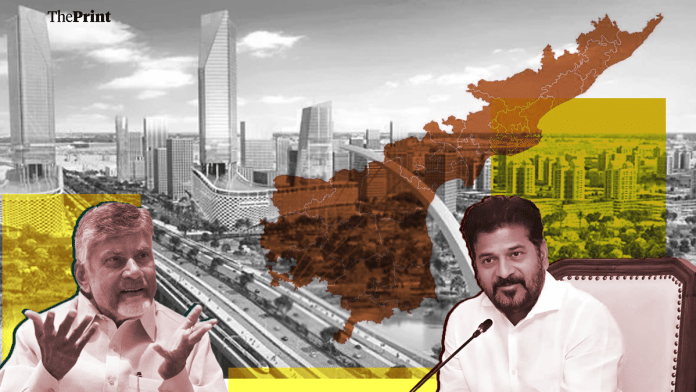
Revanth Reddy's Governance Echoes Naidu's Legacy in Telangana
On the fringes of Hyderabad, the ambitious Future City project spans 30,000 acres, aiming to transform the area into a sustainable, net-zero metropolis akin to Amaravati. This initiative adopts Andhra Pradesh’s innovative land pooling strategy to relieve congestion in the city’s heart. To navigate significant projects and policy development, Chief Minister Revanth Reddy's team includes high-profile consultants specializing in life sciences, aerospace, and artificial intelligence.
Political strategist Kalyan Chandra highlights Revanth’s reliance on external expertise, attributing this to his limited administrative experience and strained relationships with fellow cabinet members.
“Revanth is neither a visionary like Chandrababu Naidu nor a voracious reader like former Telangana CM K. Chandrashekar Rao,”Chandra observes. He suggests that while Revanth may have quickly ascended to his current role, he lacks the fiscal acumen of leaders like Karnataka’s Siddaramaiah. However, Chandra adds,
“Revanth is a street-smart politician who knows how to adapt himself to the changing political winds.”
Once a key figure in the Telugu Desam Party (TDP) and a protégé of Naidu, Revanth transitioned to Congress in 2017. Collaborating with bureaucrats, he has adopted similar unilateral governance strategies to Naidu in key administrative areas. As funding for non-BJP states is increasingly linked to central government initiatives, the overlap between the policies of Andhra Pradesh and Telangana has become more evident.
After leading Congress to victory in December 2023, insiders suggest that Revanth recognized the need for established policies to stabilize his government amid competition for leadership. Following Naidu's lead, Revanth swiftly repealed the state’s two-child policy, mirroring Andhra Pradesh’s recent decision. In 2025, he also considered adopting Andhra's land assignment model, which grants property rights to impoverished families, and sent a delegation to study how Andhra manages its overseas Telugu population.
Additionally, Telangana unveiled a midday meal scheme for junior college students in its 2026 budget, reflecting Andhra's earlier implementation. Revanth's initiative to establish 8,000 Mahila Bhavans across Telangana mirrors the Mahila Pranganams in Andhra, both designed to promote women's empowerment and economic independence. Naidu initiated the self-help group concept back in 1999, aiming to foster entrepreneurship among women.
While many of Revanth's policies are set for success, some policymakers question his originality. Nonetheless, his recent executive education program at Harvard’s Kennedy School, titled 'Leadership in the 21st Century', has drawn praise. Raka Sudhakar, a senior journalist, notes,
“Revanth Reddy never fails to acknowledge Naidu’s influence over him and even calls the latter his guru.”She further explains that Naidu's model of hiring consultants has shaped expectations for future leaders to operate like CEOs of their states.
Both Revanth and KCR have been compelled to adopt Naidu's strategies to reassure multinational corporations engaged in substantial infrastructure projects. Sudhakar comments on Hyderabad's evolution into a vital hub for software, pharmaceuticals, and finance, stating,
“Its geographic location may be in Telangana, but with foreign and domestic investors calling the city home, there is just no turning back.”She adds that Telangana must emulate Tamil Nadu's manufacturing and service growth, irrespective of shifting political landscapes.
The ongoing presence of Andhra bureaucrats and politicians in Hyderabad raises questions about the effectiveness of policy implementation across both states. As IAS officers navigate responsibilities between Telangana and Andhra Pradesh, informal discussions among the executive cadre could facilitate successful collaborations. Former TDP colleagues of Revanth assert that his political inclinations often mirror Naidu's, oscillating between centrist and cautious distancing from the Bharatiya Janata Party, aligning with Congress leadership. Ministers within his cabinet, speaking anonymously, assert that Revanth's governance style resembles Naidu’s more than Rahul Gandhi's, compelling them to adapt to his approach in safeguarding their party's foothold in Telangana and Karnataka.
Comments