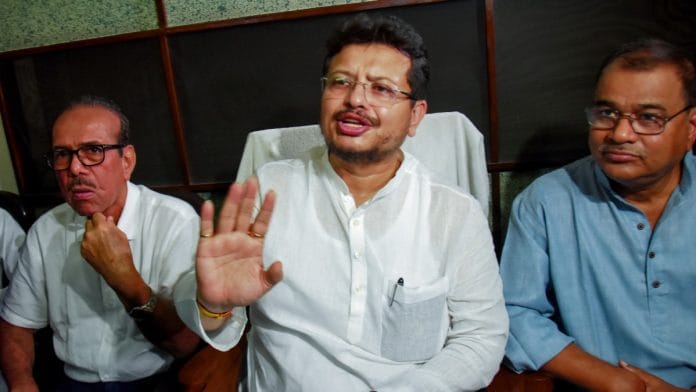
In a press conference held after the meeting with the Speaker, Ritabrata said that more than two-thirds of the MLAs elected on the Trinamool Congress symbol had submitted their claim to the Speaker, “and the claim has been accepted”. “This two-thirds strong legislative team of the Trinamool Congress inside the 18th West Bengal Legislative Assembly does not believe in ‘I’, it believes in ‘we’. Whatever norms are framed out, we have followed every norm, and that’s why we have been accepted as the principal opposition in the 18th West Bengal Legislative Assembly,” Ritabrata told reporters. Without claiming to be the real TMC, he urged Mamata Banerjee to be their “chief adviser” and give them “advice that will help us in strengthening our position as the opposition”. Also Read: Bengali film industry is switching sides after BJP’s win. New scripts on Hindu causes However, experts assert that the Speaker is only supposed to ‘recognise’ the LoP suggested by the political party, not the legislative party—which comprises a party’s elected representatives in the House. “In the Indian context, the Speaker has to merely recognise names suggested by the party. He has no other thing to do,” says constitutional expert and former Secretary General of the Lok Sabha, P.D.T. Achary. According to Achary, the political party will suggest the name of the leader of the legislature party and the Speaker only has to recognise it. “That is the process, but here if there is a split in the party, they should go to the Election Commission and decide which faction is the real party,” he tells ThePrint, adding, “It is not for the Speaker to decide that.” “How can the Speaker recognise the person who has not been suggested by the party?” he asks. Constitutional expert Prof. Faizan Mustafa says that Speaker accepting the nominee of the dissident faction basically amounts to recognising the split in a way, by accepting the nominee of the faction with two-thirds of the members of the legislative party. However, he also points out that under the anti-defection law, the provision relating to a split talks about such a split in a political party, not the legislative party, as is the case in West Bengal or in Raghav Chadha’s case. Last month, TMC general secretary Abhishek Banerjee had submitted a letter to the Speaker, announcing the party’s decision to appoint Sobhandeb Chattopadhyay as the LoP. However, two TMC MLAs, Ritabrata Banerjee and Sandipan Saha, filed a complaint with the Speaker, alleging that the TMC general secretary had forged multiple signatures in the letter. An FIR was then registered against Abhishek Banerjee and a probe was launched by the West Bengal CID. Following this, the two MLAs were expelled from the party for anti-party activities. In a matter of a couple of days, at least 58 TMC MLAs declared themselves the principal Opposition, while other party members have been resorting to social media and sharing the letters sent to the Speaker to recognise Sobhandeb Chattopadhyay as the LoP. “After the elections, the first thing that the party does is to select the leader of the legislative party. Every party does that. And then the legislative party, which is a wing of the political party, functions under the leadership of that person. The party decides it on the basis of their own constitution,” Achary explains. He asserts that the Speaker does not have to look into which faction has a two-third majority within the legislative party. If he does think that there is a dispute going on in the party, the Speaker “should step back and not decide the issue till things become clear”. “He (the Speaker) does not have to make a decision immediately. Until the matter is settled, the Speaker does not have to immediately rush in and recognise the person suggested by the faction with a two-thirds majority. Two-thirds majority of a party is not a legal requirement for recognising the Leader of Opposition,” Achary asserts. He says that if a Speaker receives a petition to disqualify someone from the political party, then he gets the jurisdiction to decide that issue. “Otherwise, the Speaker does not interfere in any political party’s internal affairs,” Achary says. Also Read: Did SIR help BJP? What data reveals about fiercely-contested West Bengal election The Supreme Court had, in May 2023, clarified pertinent legal questions in context of the political imbroglio that arose in Maharashtra as a result of the split in the Shiv Sena. The party, founded by Bal Thackeray, split in June 2022, after Eknath Shinde and several other MLAs rebelled against then-Chief Minister Uddhav Thackeray. The split also led to the collapse of the coalition government, the Maha Vikas Aghadi (MVA). At the time, newly-elected Speaker Rahul Narwekar appointed Bharat Gogawale from the Shinde faction of the Shiv Sena as chief whip of the party instead of the Thackeray faction’s nominee. However, among other things, the court ruled that the Speaker’s decision to appoint a whip from the Shinde group was “contrary to law”. It asserted that a whip can only be nominated by the political party and not the legislative party. According to Prof. Mustafa, the Supreme Court judgment in the Maharashtra crisis case favors Mamata Banerjee as it mandates members to follow the directives of the party. “If you go by the Maharashtra judgment, it says that the members have to follow the party’s whip, so the Maharashtra judgment is against this faction (Ritabrata Banerjee’s) faction,” he tells ThePrint. However, he asserts that subsequently in the Maharashtra crisis, the symbol and the party went to the Shinde faction, and “maybe history might repeat itself here too”. “So a part of the Maharashtra judgment goes in her (Mamata’s) favour, but the subsequent developments in the Maharashtra case go against her, because the ECI gave the seal (symbol) to Shinde,” he says. While the TMC faction represented by Ritabrata Banerjee has not claimed that it is the real Trinamool so far, the sequence of events in Maharashtra’s case present a picture of what such a claim may entail. Paragraph 15 of the Election Symbols (Reservation and Allotment) Order, 1968 defines the power of the ECI in relation to splinter groups or rival sections of a recognised political party. Para 15 says that when the ECI is satisfied that there are rival sections or groups of a recognised political party each of whom claims to be that party, the Commission may decide that one such rival section or group or none of such rival sections or groups is that recognised political party. ECI can do so after taking into account all the available facts and circumstances of the case and hearing such representatives of the sections or groups and other persons who want to be heard. The ECI’s decision shall be binding on all such rival sections or groups. In the Maharashtra case, the ECI, in February 2023, ordered that the Shinde camp will retain the official name and the ‘bow and arrow’ symbol of the party. Sena (UBT) challenged ECI’s decision before the Supreme Court in 2023, and the petition is currently pending. In order to decide such a claim, the ECI may rely on the test of aims and objectives as incorporated in the constitution of the party, or the test of the party constitution, or the test of majority. In its order deciding that the Shinde camp will be recognised as the real Shiv Sena, the ECI had applied the ‘test of majority’, examining which group enjoys the majority with respect to support in the legislative as well as the organisational wing of the Shiv Sena. The organisational wing comprises the totality of party members. The ECI did not apply the ‘test of the party constitution’—which checks whether the faction followed its own party’s constitution— accepting the Shinde faction’s claim that the constitution of the Shiv Sena, as amended in 2018, was “undemocratic” and subverted inner-party democracy. While the Thackeray faction submitted that there was only a split in the legislative party and not the party itself, the ECI felt that “for any dispute involving a recognised political party, where the dispute primarily revolves around the claim over a recognised symbol of the concerned political party, the legislative wing of the Party cannot be viewed in isolation”. In Shiv Sena’s case, the numbers of seats and the percentage of votes secured by the members of the Shinde faction tilted the scales in Shinde’s favour. This is an updated version of the report. (Edited by Amrtansh Arora) Also Read: TMC’s collapse does not suit BJP—because the Left is waiting in Bengal
 by
The BoldLens AI
by
The BoldLens AI
Comments